


With his real estate developing company, Octo5 (formerly Legacy Realities Ltd), Babajide Odusolu has made giant strides in real estate development in Nigeria, in private and public sectors. He was from 2013 to 2019, managing director of Ogun State Property Investment Corporation (OPIC), one of Nigeria’s largest development companies.
In the past few years, he has been active in the private sector creating innovative solutions to address Nigeria’s worsening housing crisis. In this brief interview, the lawyer-cum-real estate developer shares insights with thelaurel.com.ng on the pragmatic approach to solving Nigeria´s knotty housing problem amongst other related issues.
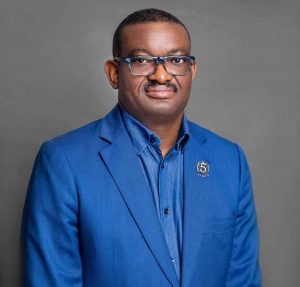
You are a thoroughbred lawyer. How did you end up in real estate?
I’m a qualified legal practitioner, a trained lawyer, with 25 years of post-call-to-bar experience. Whilst I trained as a lawyer under Babalakin & Co in 1995, I don’t enjoy litigation. I spent the bulk of my career in corporate practice, in a multinational oil company and I enjoyed public practice. Law is very versatile, with many facets. Corporate practice was what I enjoyed; I enjoy negotiating transactions than going to court. And I have passion for development. A lot of my friends were architects and when we were at the University of Ife, we used to sit down and do design work. I’m not very good at design, but I’m very creative and imaginative. So, I come up with crazy concepts, my friends actualize them. Real estate, urban planning, development has always been something I’m passionate about. Unfortunately, there is no school where you can learn to be a developer. A developer is a business person, a negotiator, a designer; a developer is a community developer, there are so many skills that come together to make a good developer but being a lawyer prepares your mind for that.
Building collapse is rife in Lagos. How can such development be curbed?
The state has done a lot to curb that. We have many agencies now including the Lagos State Safety Commission and Ministry of Physical Planning and Urban Development, which is equipped and mandated to check on the structural integrity of buildings being developed across the state. However, the real solution to effective housing solution in Nigeria is for us to go back to the basics. We do not have enough trained artisans in Nigeria. We talk about unemployment, and yet we do not have artisans in Nigeria. All developers, if you ask them, will tell you that most of the artisans that we use are usually brought in from the West Coast―Ghana, Togo, Benin Republic―because we don’t have people here who can do those jobs. To address the issue of substandard housing―I don’t want to limit it to housing collapse―we have to review the curriculum in our schools, we got to go back to vocational training development and we have to equip and enable supervisory agencies to monitor development in every nook and cranny of the country which in itself will also create more jobs.

What have you been doing with Octo5?
Between 2000 and 2005, we initiated and developed Heritage Place, a gated community in Sangotedo area. Thereafter, the company initiated and developed Ocean Bay Estate, an eighty-two and a half (82.5) acre gated community in Lafiaji, Lekki between 2003 and 2008. Both developments were unique as the first of such communities developed in their respective locations.
Why is it difficult to get a mortgage loan in Nigeria?
What you find over the year is that Nigeria has a peculiar problem. We have a lot of short-term money, not long-term money. Mortgages by their very nature are long term. For you to have mortgages, it means you must have money, money that we call patient capital; money that can be invested for 10 years, 20 years or more. The problem is, under Nigerian law, pension funds can only buy bonds. It means somebody has to bring up money, pay those mortgages before the pension funds can now buy those mortgages. In the past, it was extremely difficult because nobody was playing that role but in recent years, we have companies like Nigeria Mortgage Refinance Corporation (NMRC), Family Homes Funds and the revitalised NHS. They are now in the position to provide intermittent capital. But for COVID-19, over the next couple of years, we would have seen many more mortgages as those funds become available. What has been happening in the interim is that most developers do what they call the upper side credit. It means the developer signs an agreement with you and allows you to pay in instalments. But these are typically short term; we are not talking more than a maximum of four years. But real mortgages require long-term capital and that is difficult to come by in Nigeria for now.
Can’t we have mass housing in Nigeria?
There is what we call affordable housing, which is houses that an average person who earns a minimum of N100,000 can afford to buy and pay in instalment and there is social housing, which is what the vast majority of the low-income earners need. Social housing requires government subventions; it requires government funds because no developer can afford to tie down his money for 10 years or 20 years, collecting N5,000 or N10,000 monthly. No developer has that kind of muscle. The risk is too high. To have mass housing, government has to set aside funds to buy up houses and then offer them either to public servants or people in career employment, or government with instalment payment plans. I think that is what Lagos State is trying to do with the Lagos Home Scheme. Now the federal government is also trying to do something similar at the federal level. That is the only way we can address the issue of social housing in Nigeria, which is the same thing done everywhere in the world, using government subsidies, government subventions.